

Laboratory
Industrial Computer Engineering (ICE) Laboratory
A reconfigurable Industry 4.0/5.0 research and teaching facility for cyber-physical production systems, robotics, machine vision, industrial data analysis and digital twins, connecting real manufacturing cells through logistics, OPC UA and a software-defined control and monitoring infrastructure.
AddressVia Santa Teresa 12, 37135 Verona, ItalyTelephone+39 045 8027069
A full-scale Industry 4.0/5.0 demonstrator
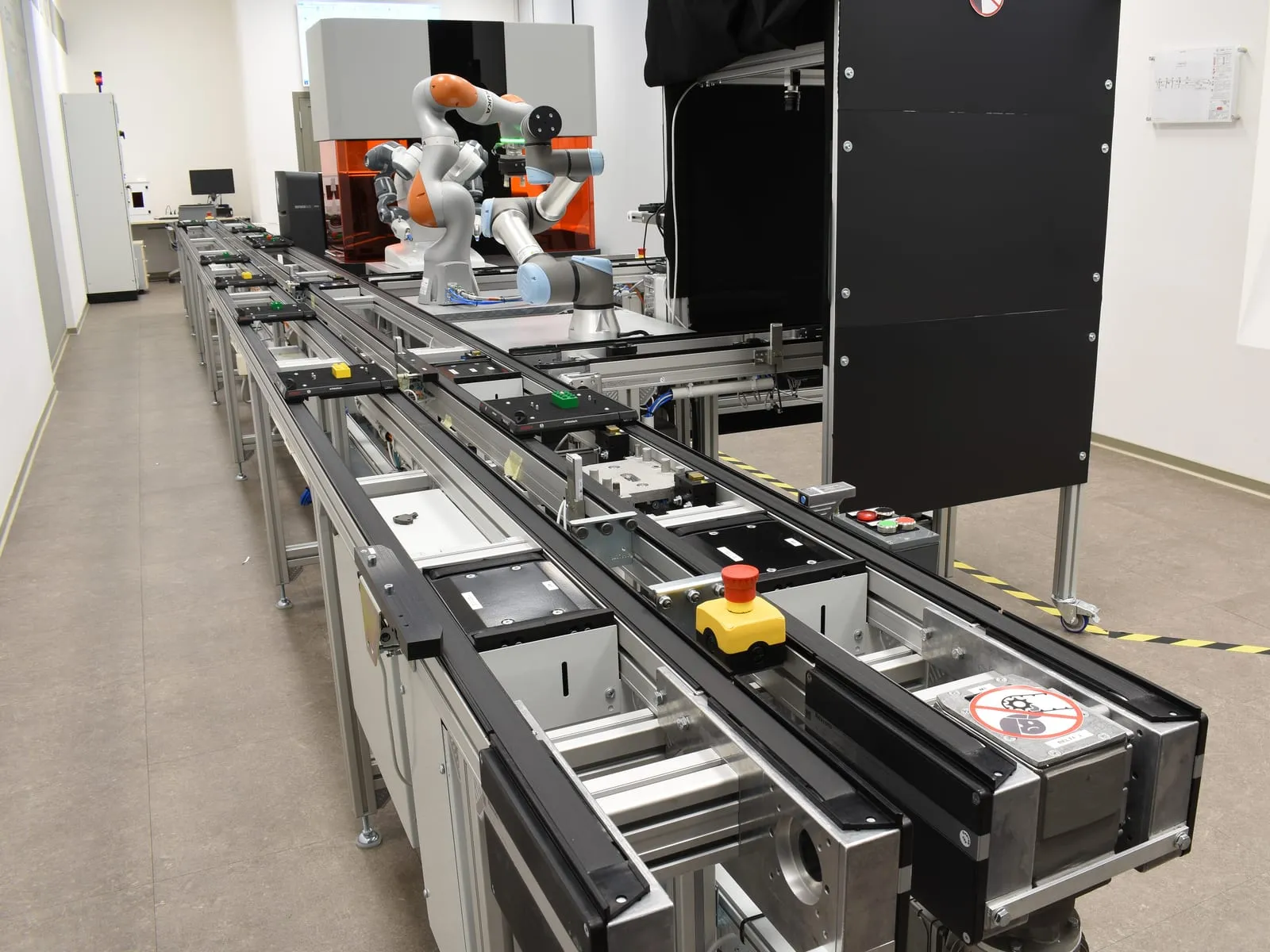
The Industrial Computer Engineering (ICE) Laboratory is a University of Verona research, education and technology-transfer facility built around a reconfigurable production line. It provides a controlled environment in which researchers, students and companies can integrate industrial machinery, robots, sensors and software without having to experiment directly on a production plant.
The laboratory was created within the University’s excellence initiative for information technology and Industry 4.0, supported by the Italian Ministry of Education, Universities and Research. Its purpose is broader than a single manufacturing demonstrator: the University identifies ICE as a reference facility for research on cyber-physical systems, robotics, image processing and production-oriented data analysis, with applications in logistics and production management. The current institutional plan is to develop ICE further as an inter-departmental laboratory.
Manufacturing and inspection cells
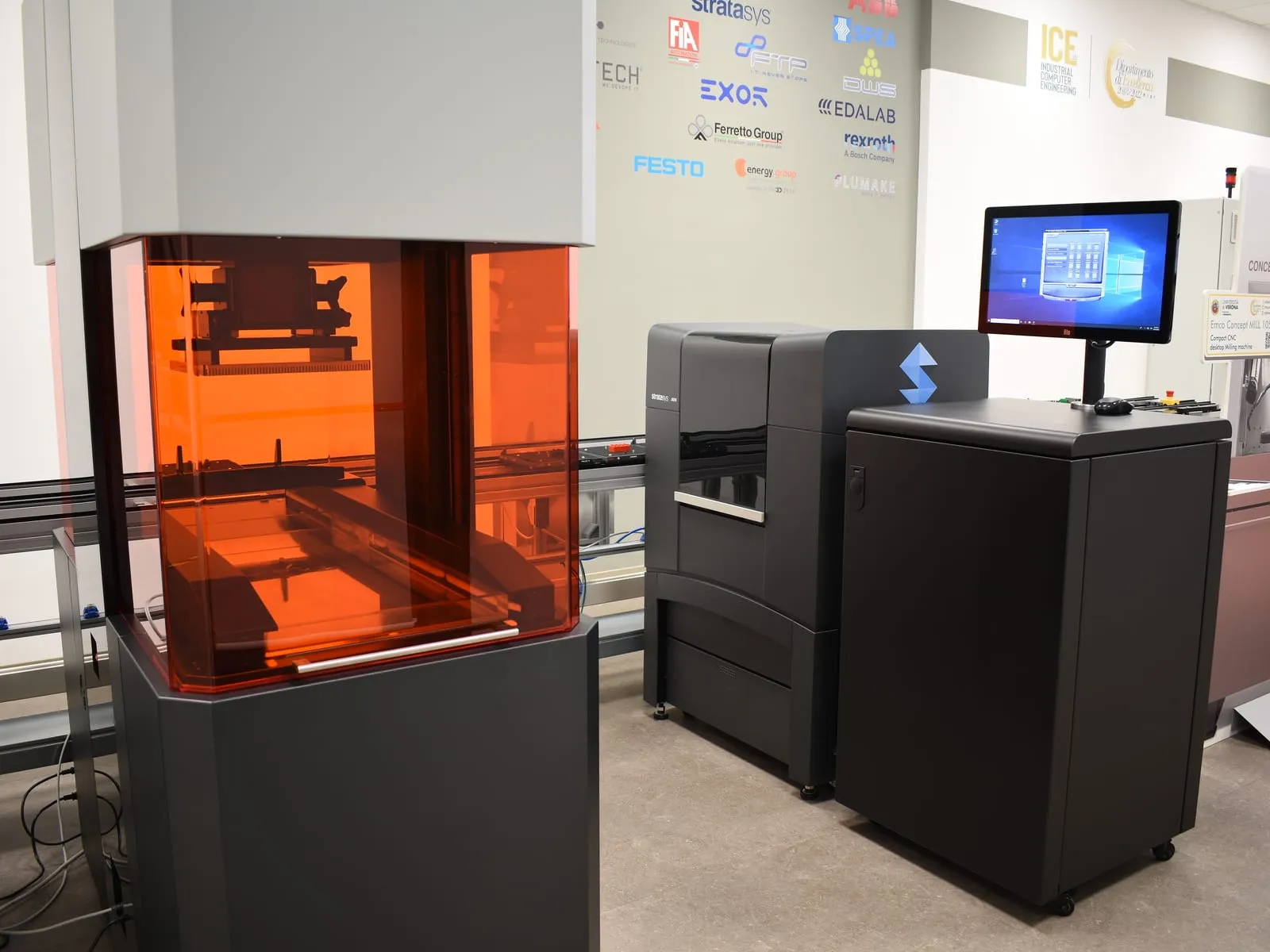
The physical line covers several complementary production stages. Functional testing is provided by a SPEA Flying Probe 4020 S2 electronic-board tester. Subtractive manufacturing uses an EMCO ConceptMill 105 CNC milling machine integrated with the laboratory automation stack, while additive manufacturing includes DWS Systems X PRO S and Stratasys J826 printers.
Assembly is built around collaborative robotics. An ABB YuMi IRB14000 and a KUKA LBR iiwa 14 R820 operate in the assembly area under a Siemens S7-1500 safety PLC. The PLC also exposes OPC UA connectivity, allowing the physical cell to participate directly in the laboratory’s service-oriented software architecture.
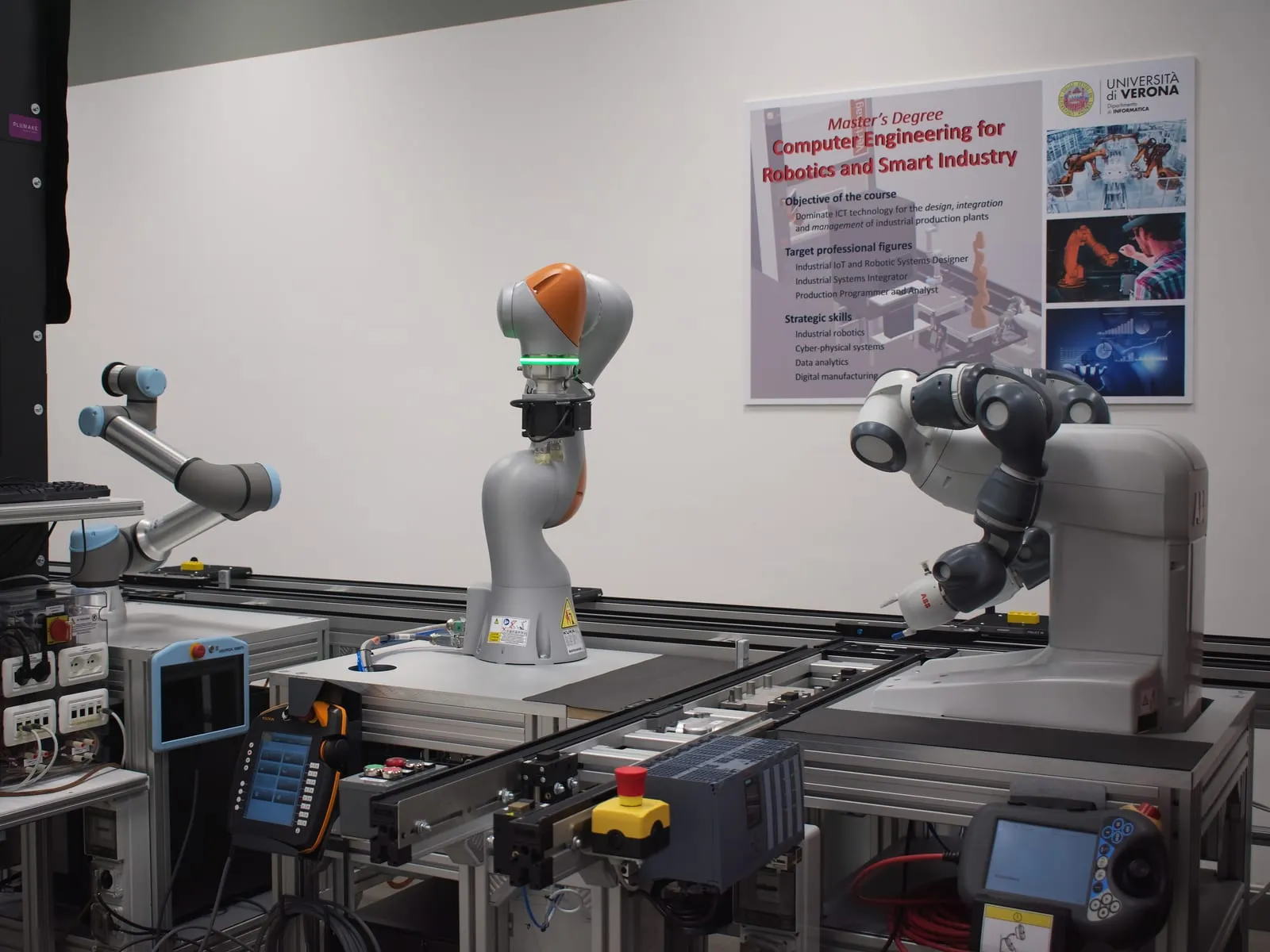
The visual-quality-control area combines industrial cameras and three-dimensional inspection. The laboratory documents a Basler camera, a Gocator laser scanner, an edge-computing system with CPU/GPU processing, and a Universal Robots UR5e manipulator that presents workpieces to the inspection system. Processing results can be exposed to the rest of the line through OPC UA.
Logistics and storage
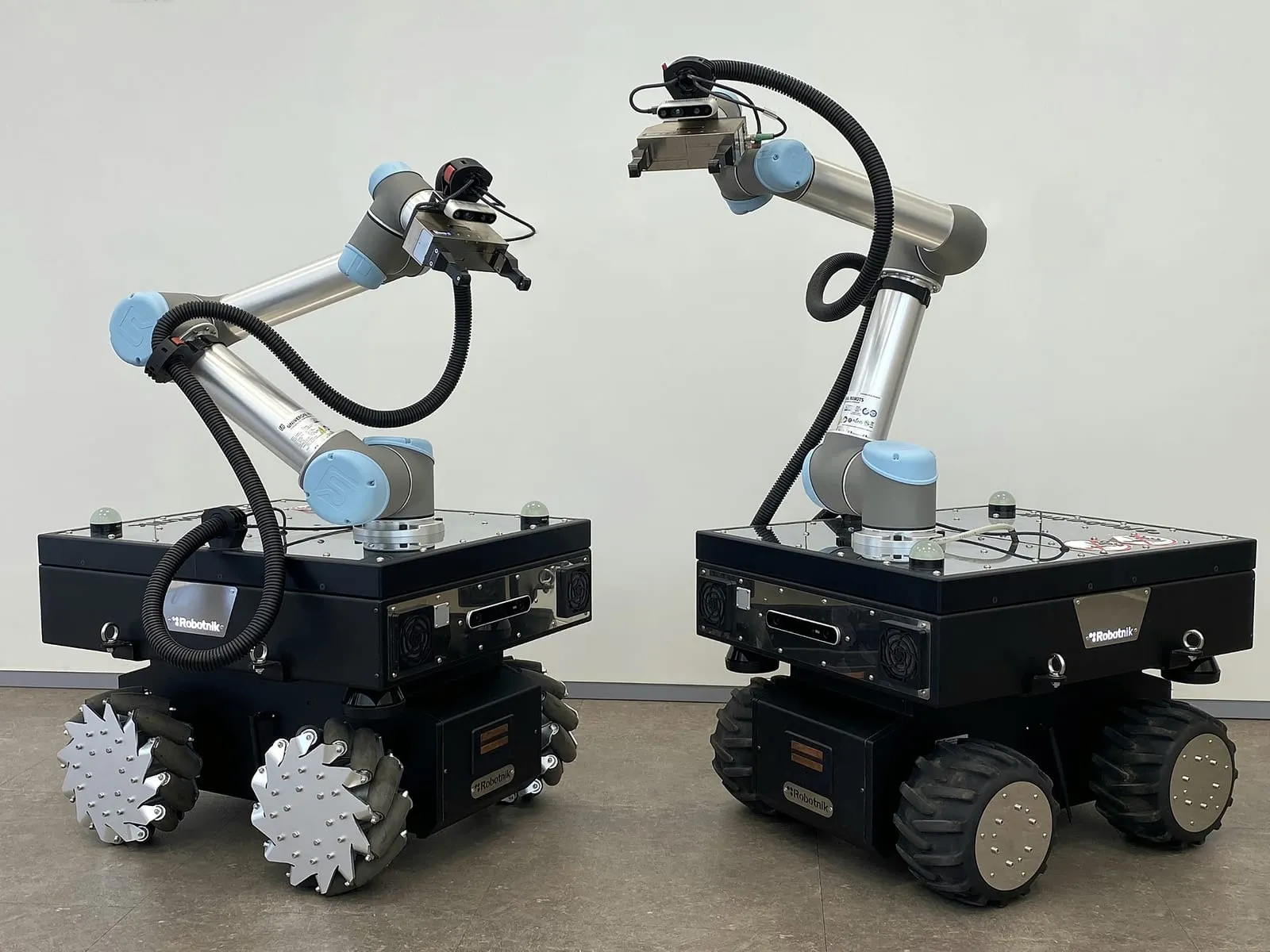
Material movement is part of the experiment rather than an external utility. A Bosch Rexroth minipallet conveyor transports and tracks workpieces between cells and can be reconfigured without a fixed route. Two Robotnik RB-KAIROS 5 mobile manipulators, based on ROS and equipped with UR5 arms, can move autonomously between stations and support automated loading of production equipment.
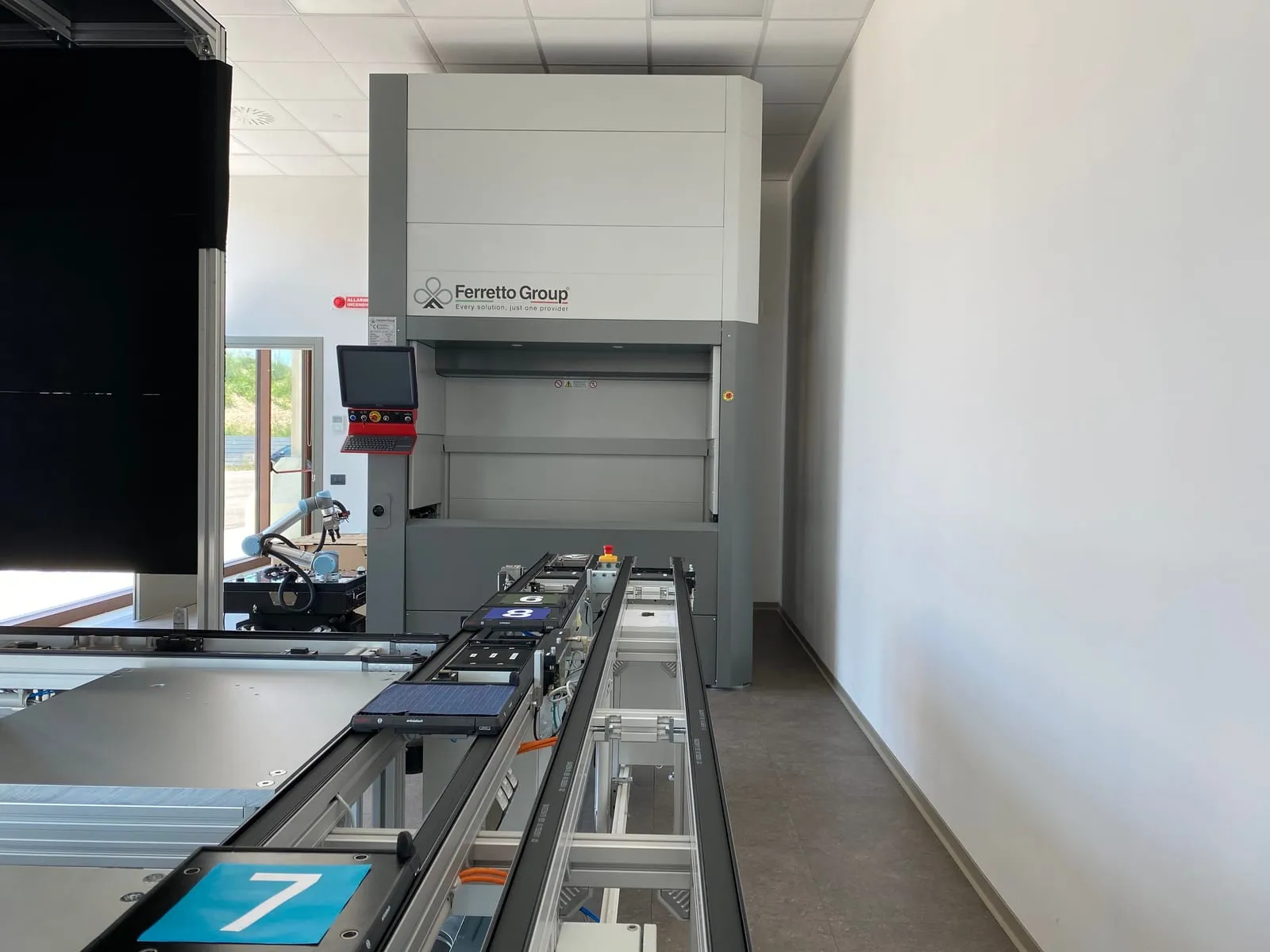
A Ferretto Group VERTIMAG EF vertical warehouse provides automated storage and retrieval. ICE uses the storage system not only operationally but also as a platform for studying optimisation strategies for part placement and production recipes.
Software-defined production
The line is tied together by a software and communication stack rather than by isolated machine controllers. Siemens Opcenter Execution Discrete provides Manufacturing Execution System functionality. A Meta-MES developed at ICE works alongside it and the data infrastructure to react to changes in plant status and production plans, using machine functions exposed through a service-oriented architecture. Communication between manufacturing areas is centred on OPC UA.
The laboratory also operates two complementary digital-twin modes in Siemens Tecnomatix Plant Simulation. The connected twin, described by ICE as a Digital Shadow, follows the real line through the machines’ OPC UA interfaces. The autonomous twin runs independently for simulation, statistics, configuration studies, timing optimisation and experiments involving equipment that is not yet physically integrated.
Industrial data infrastructure
ICE treats the information infrastructure as part of the cyber-physical system. Its data-collection architecture uses Kubernetes, microservices and CI/CD to collect, monitor and store data from laboratory equipment and IoT/IIoT sensors. The architecture can aggregate logs and alerts, perform preprocessing and selectively connect data to cloud services while retaining an extensible on-premises platform.
IoT gateways integrate environmental and energy measurements with existing industrial signals. The laboratory documents sensing for temperature, humidity, brightness, presence, air quality and machine energy consumption, with OPC UA used to make collected information available to the wider control and monitoring infrastructure.
Research, teaching and technology transfer
ICE is used as a common physical platform for research on digital twins, production-system modelling, scheduling and reconfiguration, industrial communications, machine vision, robotics, data analysis and human interaction with cyber-physical factories. Laboratory teaching in the University’s computer-engineering programmes uses the production plant directly, while companies can use ICE to demonstrate and evaluate technologies in a controlled industrial setting.
A 2024 VRST demonstration illustrates this research role through a high-fidelity virtual-reality digital twin of the ICE facility, allowing users to explore the laboratory and inspect live or simulated machine information from an immersive representation.