Library
EDACurry
An open-source multi-language framework for creating, translating and manipulating transistor-level netlists through a unified abstract syntax tree, with C++ and Python interfaces for conversion, analysis, defect injection and custom analog-design workflows.
LicenceMIT
A common semantic layer for SPICE-family netlists
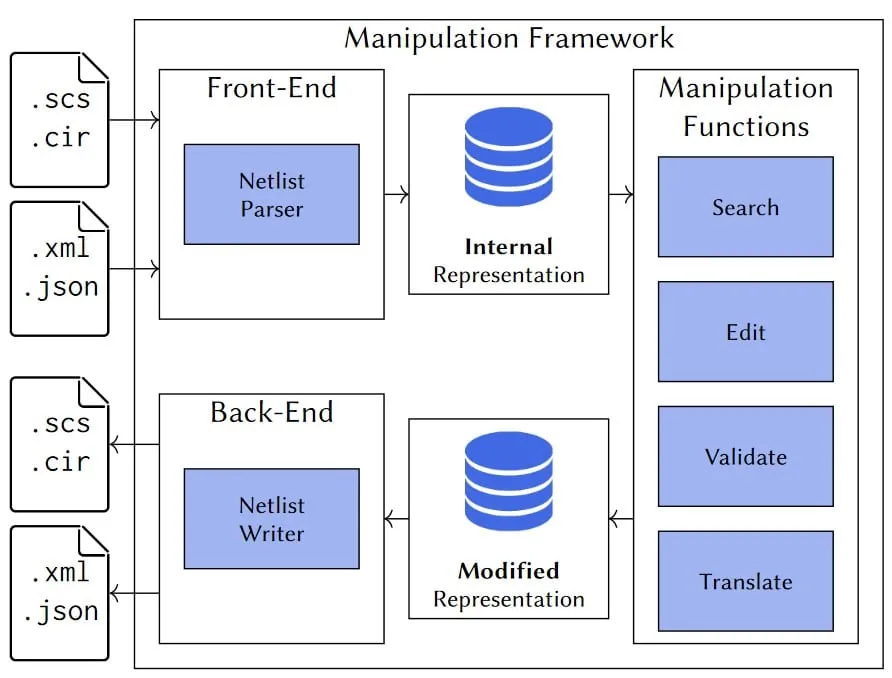
Transistor-level design flows use many SPICE-derived languages. They often describe closely related circuit concepts while differing in syntax, supported constructs and tool-specific conventions. EDACurry addresses that fragmentation with a shared internal semantic model: language-specific front ends parse a netlist into one abstract syntax tree (AST), tools manipulate that representation, and back ends emit the desired target language.
The result is not simply a source-to-source converter. The common AST creates an intermediate layer on which analysis and transformation tools can be written once and reused across supported netlist formats.
Conversion and manipulation workflows
The current framework supports SPICE-family languages including Eldo and Spectre. Its core is implemented in C++, while Python access makes the same representation available to scripts and higher-level workflows. Public descriptions of EDACurry document operations including design-space exploration, defect-model injection and subcircuit wrapping, as well as integration with commercial and open-source simulation flows.
The architecture exposes APIs together with visitor/listener-style mechanisms so users can implement transformations without rewriting a parser. This separation is important in analog and mixed-signal design automation, where the same structural operation may need to be applied to netlists originating from different tools.
Serialisation and tool chaining
EDACurry can serialise its in-memory representation through a JSON back end and reconstruct it through the corresponding front end. That creates a neutral interchange point for chaining independent tools: one stage can parse and transform a netlist, another can operate on the serialised representation, and a later stage can regenerate the desired circuit language.
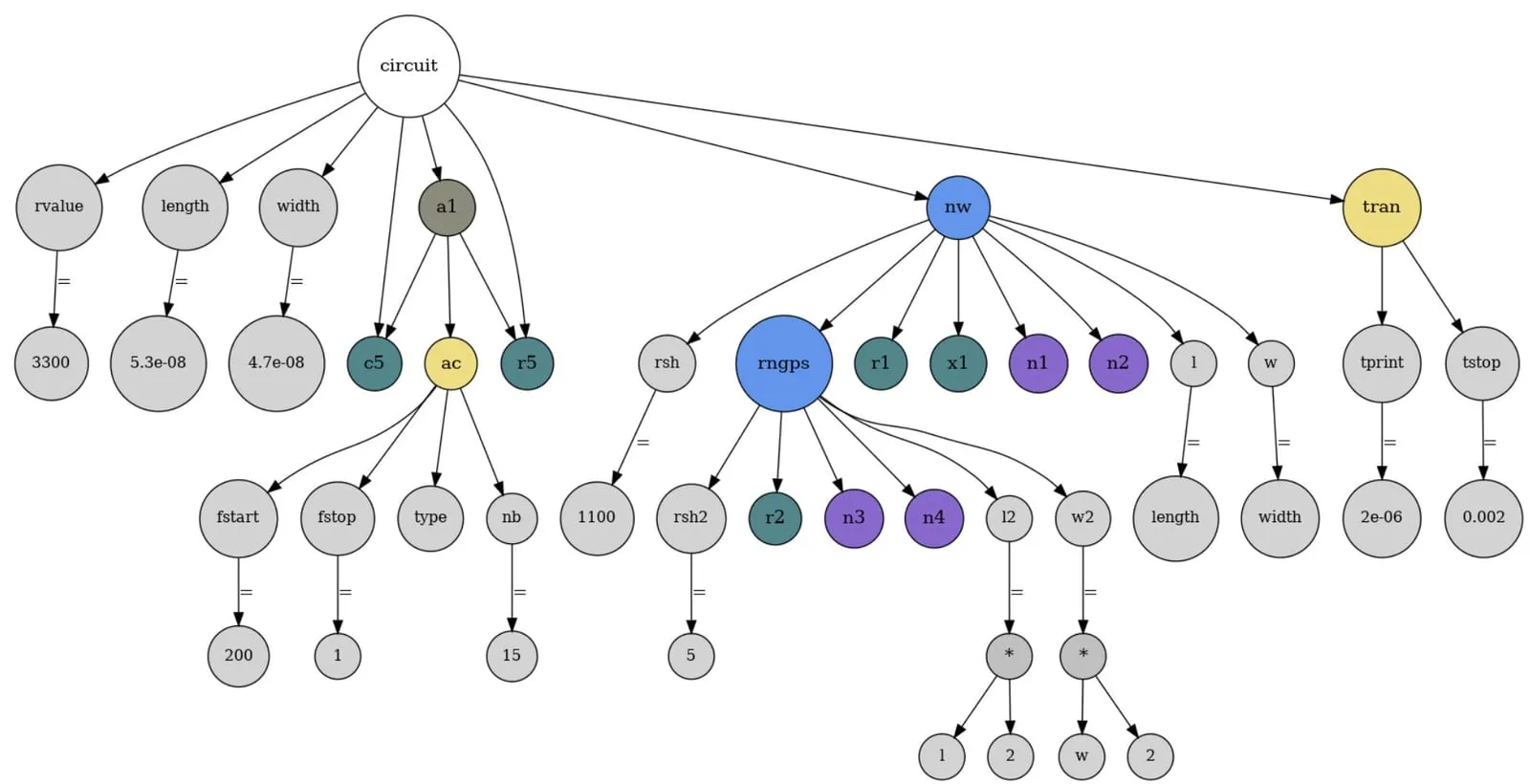
A companion visualisation workflow converts the JSON representation into DOT/GraphViz form, making the internal structure inspectable as a tree.
Scalability and current implementation
The public EDACurry repository includes scalability experiments for Eldo and Spectre netlists with up to 200,000 components. The reported measurements show approximately linear growth in parsing and writing time over those benchmarks, with near-constant per-device cost. The repository also contains the grammars, parser/manipulation sources, auxiliary tools and tests used by the project.
A 2025 IEEE Transactions on Computer-Aided Design of Integrated Circuits and Systems article presents the current framework and its applications, including Python-accessible custom transformations and interoperability with analog-design tools. The maintained public repository is now hosted by the esd-univr organisation.
Availability
EDACurry is distributed under the MIT License. The repository contains the source code, build and contribution information, tests and benchmark material.